
Record intervention bought the Japanese Yen a return to mid-May
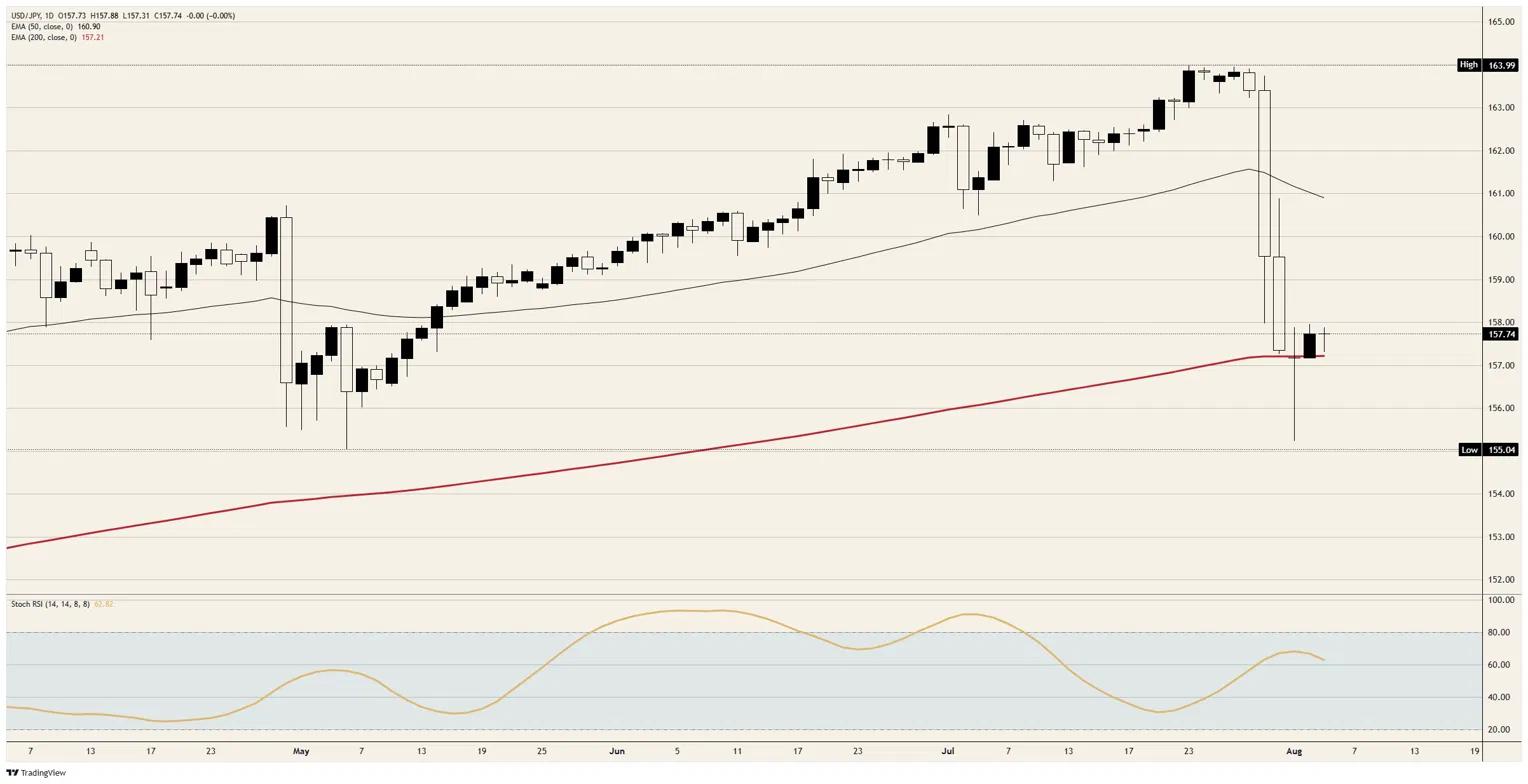
- USD/JPY trades just above 157.50, unchanged and pinned to its 200-day EMA.
- Tokyo spent a reported 8.45 trillion Yen in one day, the largest ever.
- The Fed facility Japan wants enlarged is capped at 60 billion Dollars.
The pair changes hands just above 157.50, flat on the session and sitting directly on a 200-day Exponential Moving Average (EMA) that has risen to meet it. The range covers less than 60 pips. After the sharpest four-session decline in almost two years, the most violent currency in the majors has gone completely still.
Where it has stopped is the whole story. A week ago the pair printed just under 164.00, a four-decade extreme. It now trades at a level last seen in mid-May, which means the largest coordinated intervention on record has bought back roughly eleven weeks of Yen depreciation and no more.
What fourteen trillion Yen actually purchased
Japan's Ministry of Finance is reported to have spent 8.45 trillion Yen in a single day, the largest one-session operation ever recorded, followed by roughly 5.3 trillion the next. The American Treasury joined it, buying Yen for the first time since 2011 and funding the purchase by selling euros rather than Dollars, which tells you the operation was designed with the Treasury market in mind as much as the currency.
The result is a currency that stopped falling the moment the spending stopped. Price has held a narrow band around the 200-day EMA for three sessions without either side pressing, which is what a market looks like when it has found the level authorities are defending and is waiting to see whether they will pay again. Intervention establishes a price. It does not establish a reason.
The differential that caused this is untouched
The Federal Reserve holds at 3.50% to 3.75% with three policymakers dissenting for an increase and no cut priced at any 2026 meeting. The Bank of Japan sits at 1.00% after a seven to one vote in June took the policy rate to a 31-year high. That gap is the machine driving the Yen down, and a currency operation does not touch it.
The June minutes published Wednesday show a board moving toward the only real fix. Several members expected consumer inflation to receive a significant boost in the second half of the fiscal year as firms raise prices across a broad range of goods, two argued for moving faster toward a neutral setting, and one warned that inflationary pressure would persist even if the Middle East conflict resolves, because sourcing alternative supply carries elevated shipping and storage costs. The July meeting pointed future discussion at upside price risks, which the market reads as September being live.
The backstop nobody has voted on
The Foreign and International Monetary Authorities (FIMA) repo facility lets approved foreign authorities raise Dollars against their Treasury holdings instead of selling them, capped at 60 billion Dollars per institution. Japan holds roughly 1.1 trillion Dollars of American government debt, the largest foreign stack in existence, and Tokyo has said it intends to use the facility. Selling those bonds to fund Yen purchases would push American yields up, which nobody in Washington wants.
The American Treasury Secretary has publicly asked for the cap to be raised and pledged to repeat the joint operation. The Federal Reserve has declined to comment, and any expansion requires a majority of the same committee that split three ways nine days ago. Traders are treating an enlarged backstop as though it exists. It is currently a request made on social media, and the institution that would have to approve it has spent two months insisting it does not take its cue from market prices.
What lands before Friday
American weekly jobless claims arrive Thursday at 12:30 GMT with a 202K consensus against 197K, followed by Friday's payrolls report at the same hour, consensus 80K after 57K with the unemployment rate seen at 4.2%. Private payrolls already missed badly on Wednesday at 44K against 70K, and the services employment index fell to 47.4.
Both branches run through this pair. A second soft American labour print narrows the rate gap without Tokyo spending another Yen, which is the outcome Japanese authorities need and cannot manufacture. A firm number rebuilds the differential and puts the Ministry of Finance straight back on the bid, this time defending a level the market has already watched it choose.
Levels and bias
Resistance: 158.00 caps the immediate reaction, with 158.50 above it and the declining 50-day EMA near 161.00 marking where the pre-intervention structure begins again.
Support: The 200-day EMA just above 157.00 is the pivot, with 156.00 beneath it and the intervention spike low near 155.00 as the line authorities have already proved they will defend.
Bias: Bearish. A daily Stochastic Relative Strength Index (Stoch RSI) near 63 and flattening confirms that neither side owns this level yet. Rallies into 158.50 are for selling while the 50-day EMA declines overhead, and a daily close beneath 157.00 opens 156.00 then the 155.00 area. Invalidation is a daily close above 160.00, which would signal the market has decided the backstop is bluff rather than budget.
USD/JPY daily chart
Japanese Yen FAQs
The Japanese Yen (JPY) is one of the world’s most traded currencies. Its value is broadly determined by the performance of the Japanese economy, but more specifically by the Bank of Japan’s policy, the differential between Japanese and US bond yields, or risk sentiment among traders, among other factors.
One of the Bank of Japan’s mandates is currency control, so its moves are key for the Yen. The BoJ has directly intervened in currency markets sometimes, generally to lower the value of the Yen, although it refrains from doing it often due to political concerns of its main trading partners. The BoJ ultra-loose monetary policy between 2013 and 2024 caused the Yen to depreciate against its main currency peers due to an increasing policy divergence between the Bank of Japan and other main central banks. More recently, the gradually unwinding of this ultra-loose policy has given some support to the Yen.
Over the last decade, the BoJ’s stance of sticking to ultra-loose monetary policy has led to a widening policy divergence with other central banks, particularly with the US Federal Reserve. This supported a widening of the differential between the 10-year US and Japanese bonds, which favored the US Dollar against the Japanese Yen. The BoJ decision in 2024 to gradually abandon the ultra-loose policy, coupled with interest-rate cuts in other major central banks, is narrowing this differential.
The Japanese Yen is often seen as a safe-haven investment. This means that in times of market stress, investors are more likely to put their money in the Japanese currency due to its supposed reliability and stability. Turbulent times are likely to strengthen the Yen’s value against other currencies seen as more risky to invest in.